How Do You Know if You Get Spam or Not
Phishing is one of the most common methods of cyber criminal offence, but despite how much we call up we know about scam emails, people notwithstanding oftentimes fall victim.
Action Fraud receives more than 400,000 reports of phishing emails each year, and co-ordinate to the Mimecast's State of E-mail Security 2020, 58% of organisations saw phishing attacks increase in the by 12 months.
Meanwhile, Verizon'south latest Data Alienation Investigations Study found that more than than two thirds of data breaches involved social engineering attacks such as phishing.
In this blog, we utilize real phishing electronic mail examples to demonstrate 5 clues to help you spot scams.
i. The bulletin is sent from a public e-mail domain
No legitimate system will send emails from an address that ends '@gmail.com'.
Not even Google.
Most organisations, except some small operations, volition accept their own email domain and company accounts. For case, legitimate emails from Google will read '@google.com'.
If the domain name (the bit after the @ symbol) matches the apparent sender of the email, the message is probably legitimate.
The best way to check an organisation'south domain name is to type the company's proper noun into a search engine.
This makes detecting phishing seem easy, only cyber criminals take plenty of tricks upwards their sleeves to deceive you.
Top tip: Expect at the e-mail address, not simply the sender
Many of us don't ever await at the email address that a message has come up from.
Your inbox displays a proper noun, similar 'It Governance', and the subject line. When you lot open the email, you already know (or retrieve you know) who the bulletin is from and jump straight into the content.
When crooks create their bogus email addresses, they frequently have the choice to select the display name, which doesn't take to relate to the e-mail address at all.
They can, therefore, use a artificial e-mail address that volition plow up in your inbox with the display name Google.
Just criminals rarely depend on their victim's ignorance alone. Their bogus electronic mail addresses will use the spoofed organisation'south name in the local part of the address.
Have this example of a phishing electronic mail mimicking PayPal:

Image: WeLiveSecurity
This is a well-nigh flawless scam electronic mail. It uses PayPal'due south logo at the meridian of the message, it is styled professionally and the request is believable.
Just every bit much as it attempts to replicate a genuine e-mail from PayPal, there's one huge red flag: the sender's accost is 'paypal@notice-access-273.com'.
A genuine email from PayPal would have the organisation'south proper noun in the domain proper noun, indicating that it had come up from someone at (@) PayPal. That PayPal isn't in the domain proper name is proof that this is a scam.
Unfortunately, simply including PayPal anywhere in the message is frequently enough to fob people.
They might glance at the word PayPal in the e-mail address and exist satisfied, or simply not understand the difference betwixt the domain name and the local function of an electronic mail accost.
Want to educate your staff on the threat of phishing?
Our Phishing Staff Awareness Preparation Programme at present comes with 50% off your start licence.
Simply enter the code PHISHING50 at the checkout.
ii. The domain name is misspelt
There'due south another clue hidden in domain names that provide a stiff indication of phishing scams – and it unfortunately complicates our previous clue.
The trouble is that anyone can buy a domain proper noun from a registrar. And although every domain name must be unique, there are enough of ways to create addresses that are duplicate from the one that's being spoofed.
The Gimlet Media podcast 'Reply All' demonstrated how hard it can be to spot a spoofed domain in the episode What Kind Of Idiot Gets Phished?. Phia Bennin, the prove's producer, hired an ethical hacker to phish various employees.
The hacker bought the domain 'gimletrnedia.com' (that's r-n-e-d-i-a, rather than m-east-d-i-a) and impersonated Bennin.
His scam was then successful that he tricked the show's hosts, Gimlet Media'southward CEO and its president.
Yous don't demand to fall victim to assistance criminal hackers
As Bennin went on to explicate, you don't even need to fall victim for a criminal hacker to gain vital data.
In this scam, the upstanding hacker, Daniel Boteanu, could come across when the link was clicked, and in ane example that information technology had been opened multiple times on different devices.
He reasoned that the target'south curiosity kept bringing him dorsum to the link only that he was suspicious enough not to follow its instructions.
Boteanu explains:
I'g guessing [the target] saw that something was going on and he started digging a chip deeper and […] trying to find out what happened […]
And I'm suspecting that subsequently, [the target] maybe sent an email internally proverb, "Hey guys! This is what I got. Just be conscientious. Don't click on this […] email.
Boteanu's theory is exactly what had happened. Merely why does that assistance the hacker? Bennin elaborates:
The reason Daniel had idea [the target] had washed that is because he had sent the same email to a bunch of members of the squad, and after [the target] looked at information technology for the fourth fourth dimension, nobody else clicked on it.
And that'southward okay for Daniel because he tin attempt, like, all unlike methods of phishing the team, and he can try information technology a bunch of different times. [And] since [the target is] sounding warning bells, he probably won't include [him] in the next phishing attempt.
Therefore, in many means, criminal hackers often still win even when y'all've thwarted their initial attempt.
That is to say, indecisiveness in spotting a phishing scam provides clues to the scammer nearly where the strengths and weaknesses in your organization are.
It takes very little endeavor for them to launch subsequent scams that brand apply of this information, and they tin keep doing this until they find someone who falls victim.
Call back, criminal hackers just crave 1 error from one employee for their functioning to be a success. As such, everyone in your organisations must exist confident in their ability to spot a scam upon start seeing it.

3. The email is poorly written
Yous can often tell if an email is a scam if it contains poor spelling and grammer.
Many people volition tell you that such errors are role of a 'filtering organisation' in which cyber criminals target only the about gullible people.
The theory is that, if someone ignores clues about the way the message is written, they're less likely to choice upwardly clues during the scammer's endgame.
However, this but applies to outlandish schemes like the oft-mocked Nigerian prince scam, which you have to be incredibly naive to autumn victim to.
That, and scams like information technology, are manually operated: one time someone takes to the bait, the scammer has to reply. As such, it benefits the crooks to make sure the pool of respondents contains only those who might believe the balance of the con.
Merely this doesn't apply to phishing.
Automated attacks
With phishing, scammers don't demand to monitor inboxes and transport tailored responses. They but dump thousands of crafted letters on unsuspecting people.
As such, there's no need to filter out potential respondents. Doing and so reduces the pool of potential victims and helps those who didn't fall victim to warning others to the scam, similar we saw in the earlier example with Gimlet Media.
And so why are so many phishing emails poorly written? The nigh obvious answer is that the scammers aren't very practiced at writing.
Remember, many of them are from non-English-speaking countries and from backgrounds where they will have limited access or opportunity to learn the language.
With this in listen, it becomes a lot easier to spot the difference between a typo made by a legitimate sender and a scam.
Tiptop tip: Look for grammatical mistakes, non spelling mistakes
When crafting phishing messages, scammers will often use a spellchecker or translation machine, which will give them all the right words only not necessarily in the proper context.
Take this example of a scam imitating Windows:
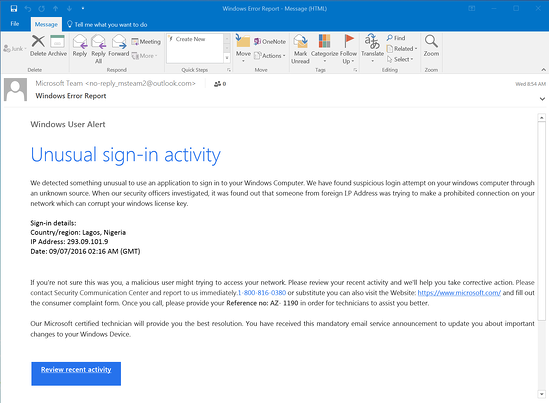
Image: KnowBe4
No individual discussion is spelled incorrectly, but the message is full of grammatical errors that a native speaker wouldn't brand, such as "We detected something unusual to apply an application".
Also, there are strings of missed words, such equally in "a malicious user might trying to admission" and "Please contact Security Communication Centre".
These are consistent with the kinds of mistakes people make when learning English. Any supposedly official bulletin that'due south written this way is almost certainly a scam.
That'south not to say whatsoever electronic mail with a mistake in it is a scam, however. Everyone makes typos from fourth dimension to time, peculiarly when they're in a hurry.
It'south therefore the recipient's responsibility to look at the context of the error and decide whether it's a clue to something more than sinister. You can do this by request:
- Is information technology a common sign of a typo (like hitting an next cardinal)?
- Is it a mistake a native speaker shouldn't make (grammatical incoherence, words used in the wrong context)?
- Is this email a template, which should take been crafted and copy-edited?
- Is it consistent with previous messages I've received from this person?
If you're in whatsoever doubt, expect for other clues that we've listed here or contact the sender using another line of communication, whether that's in person, by phone, via their website, an alternative email accost or through an instant bulletin client.
four. It includes suspicious attachments or links
Phishing emails come in many forms. Nosotros've focused on emails in this article, but y'all might also get scam text messages, phone calls or social media posts.
Only no thing how phishing emails are delivered, they all contain a payload. This will either be an infected zipper that you're asked to download or a link to a artificial website.
The purpose of these payloads is to capture sensitive information, such as login credentials, credit card details, phone numbers and business relationship numbers.
What is an infected attachment?
An infected zipper is a seemingly benign document that contains malware. In a typical example, like the one below, the phisher claims to be sending an invoice:

Source: MailGuard
It doesn't thing whether the recipient expects to receive an invoice from this person or not, considering in most cases they won't be certain what the message pertains to until they open the attachment.
When they open up the attachment, they'll see that the invoice isn't intended for them, but it will exist too late. The document unleashes malware on the victim'southward calculator, which could perform whatever number of nefarious activities.
We advise that you never open an attachment unless you are fully confident that the bulletin is from a legitimate party. Even then, yous should look out for anything suspicious in the attachment.
For case, if you receive a pop-upwardly alert about the file's legitimacy or the application asks you to suit your settings, then don't go on.
Contact the sender through an culling means of communication and ask them to verify that it's legitimate.
Suspicious links
Y'all can spot a suspicious link if the destination address doesn't lucifer the context of the remainder of the email.
For example, if you receive an email from Netflix, yous would expect the link to straight you towards an address that begins 'netflix.com'.
Unfortunately, many legitimate and scam emails hide the destination address in a button, so information technology's not immediately apparent where the link goes to.

Source: Malware Traffic Assay
In this example, you would probably know that something was suspicious if you saw the destination address in the e-mail.
Unfortunately, the residuum of the message is pretty convincing, and you might click the link without giving it a second thought.
To ensure you don't fall for schemes like this, you must train yourself to check where links get before opening them.
Thankfully, this is straightforward: on a computer, hover your mouse over the link, and the destination accost appears in a small-scale bar along the bottom of the browser.
On a mobile device, hold down on the link and a pop-upwards volition appear containing the link.
5. The bulletin creates a sense of urgency
Scammers know that most of the states procrastinate. Nosotros receive an email giving us important news, and we decide we'll deal with information technology later.
But the longer you think about something, the more likely you are to discover things that don't seem right.
Maybe you realise that the organisation doesn't contact you lot past that email accost, or y'all speak to a colleague and learn that they didn't send yous a document.
Even if you don't get that 'a-ha' moment, coming back to the message with a fresh set of eyes might help reveal its true nature.
That's why and then many scams request that you lot act now or else it will be too tardily. This has been axiomatic in every example we've used so far.
PayPal, Windows and Netflix all provide services that are regularly used, and whatever issues with those accounts could cause immediate inconveniences.
The business depends on yous
The manufactured sense of urgency is every bit effective in workplace scams.
Criminals know that we're likely to drop everything if our boss emails us with a vital request, especially when other senior colleagues are supposedly waiting on the states.
A typical example looks like this:

Source: MailGuard
Phishing scams similar this are especially dangerous considering, even if the recipient did suspect foul play, they might exist besides afraid to confront their boss.
Later all, if they are wrong, they're essentially implying that there was something unprofessional virtually the boss's request.
However, organisations that value cyber security would accept that it'southward better to exist safe than distressing and perhaps fifty-fifty congratulate the employee for their caution.
Foreclose phishing past educating your employees
To combat the threat of phishing, organisations must provide regular staff awareness training.
Information technology's only past reinforcing advice on avoiding scams that your team can develop good habits and observe malicious letters every bit second nature.
With our Phishing Staff Awareness Training Program, these lessons are straightforward.
The online subscription grade explains everything you lot need to know about phishing, and is updated each month to encompass the latest scams.
Book this form today to receive 50% off your first license. Just enter the code PHISHING50 at the checkout.
A version of this weblog was originally published on 16 March 2018.

Source: https://www.itgovernance.co.uk/blog/5-ways-to-detect-a-phishing-email
0 Response to "How Do You Know if You Get Spam or Not"
Postar um comentário